Dunhuang Is the Site of a Great Collection of Early Chinese Art That Fills the Quizlet
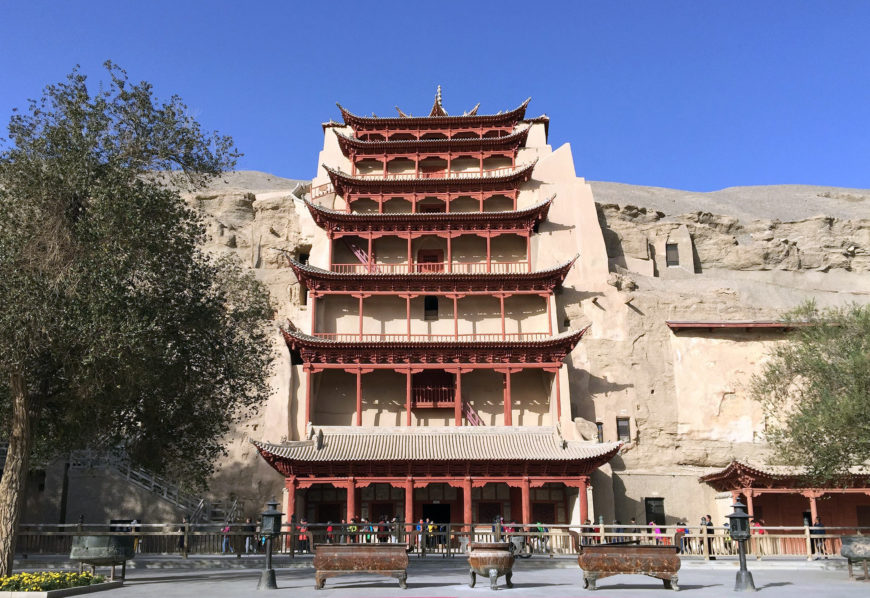
Mogao Caves (photo: 慕尼黑啤酒 , CC By-SA 3.0)
A trove of Buddhist art
The 'Caves of the Grand Buddhas' (Qianfodong), likewise known equally Mogao, are a magnificent treasure trove of Buddhist fine art. They are located in the desert, most fifteen miles south-east of the town of Dunhuang in north western China. By the tardily 4th century, the area had become a busy desert crossroads on the caravan routes of the Silk Road linking Prc and the West. Traders, pilgrims, and other travelers stopped at the oasis town to secure provisions, pray for the journeying alee or give thanks for their survival. Records state that in 366 monks carved the first caves into the cliff stretching about 1 mile forth the Daquan River.
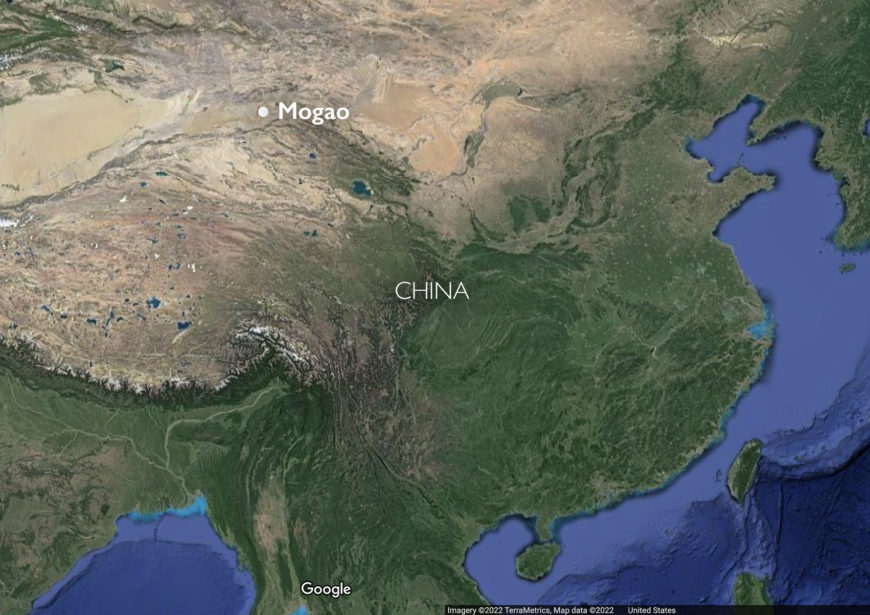
Location of Mogao caves in China (underlying map © Google)
An archive rediscovered
At some point in the early eleventh century, an incredible archive—with upwards to l,000 documents, hundreds of paintings, together with textiles and other artefacts—had been sealed upwards in a sleeping room adjacent to i of the caves (Cavern 17). Its entrance was concealed backside a wall painting and the trove remained hidden from sight for centuries. In 1900, information technology was discovered by Wang Yuanlu, a Daoist monk who had appointed himself abbot and guardian of the cave-temples. The first Western trek to reach Dunhuang arrived in 1879. More than twenty years later Hungarian-born Marc Aurel Stein, a British archaeologist and explorer, learned of the importance of the caves.
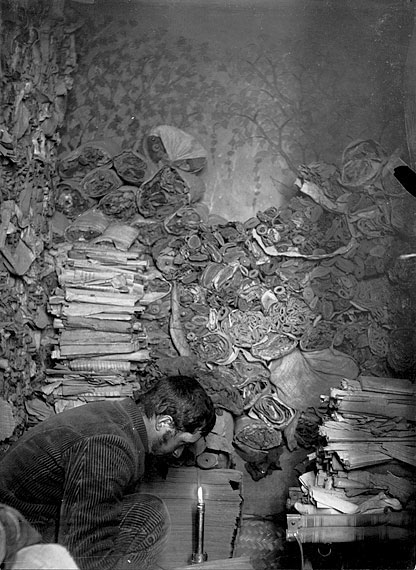
Paul Pelliot working in the library cavern in 1908 (photo: Bahatur, public domain)
Stein reached Dunhuang in 1907. He had heard rumors of the walled-in cave and its contents. The abbot sold Stein seven 1000 complete manuscripts and vi one thousand fragments, as well as several cases loaded with paintings, embroideries and other artifacts. French explorer Paul Pelliot followed close on Stein's heels. Pelliot remarked in a letter, "During the showtime 10 days I attacked nearly a thousand scrolls a 24-hour interval…."
Other expeditions followed and returned with many manuscripts and paintings. The result is that the Dunhuang manuscripts and scroll paintings are now scattered over the globe. The bulk of the textile can be found in Beijing, London, Delhi, Paris, and Saint Petersburg. Studies based on the textual material found at Dunhuang accept provided a improve understanding of the extraordinary cross-fertilization of cultures and religions that occurred from the fourth through the fourteenth centuries.
A yard years of art
There are about 492 extant cave-temples ranging in appointment from the fifth to the thirteenth centuries. During the one thousand years of artistic activity at Dunhuang, the style of the wall paintings and sculptures changed. The early caves show greater Indian and Western influence, while during the Tang dynasty (618–906 C.Due east.) the influence of the Chinese painting styles of the imperial court is credible. During the 10th century, Dunhuang became more isolated and the organization of a local painting academy led to mass production of paintings with a unique style.
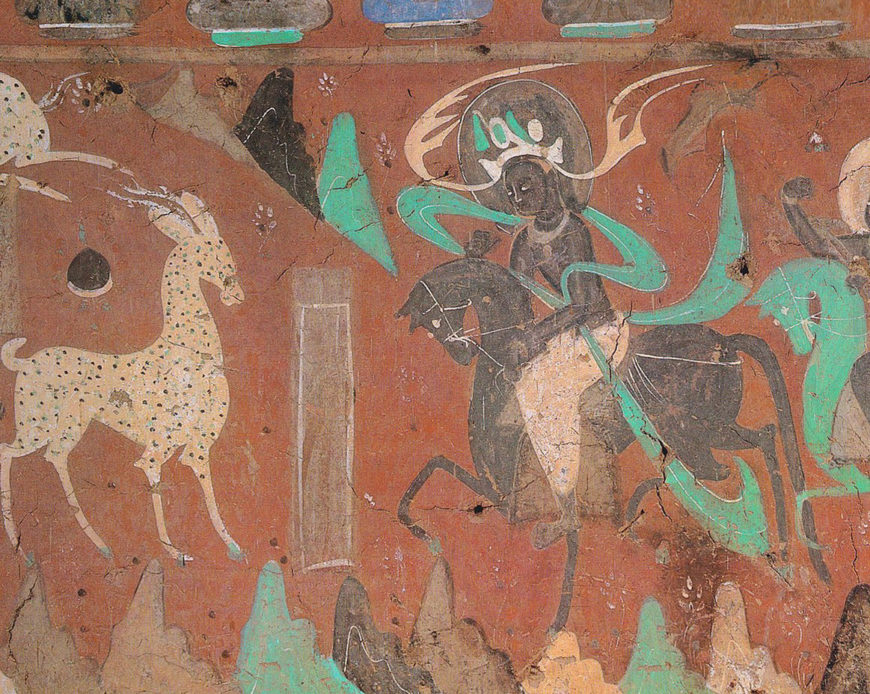
Mural, Cave-temple 257, Dunhuang, Gansu Province (photo: Ismoon, CC By-SA four.0)
The cave-temples are all homo-made, and the decoration of each appears to have been conceived and executed as a conceptual whole. The wall-paintings were done in dry fresco. The walls were prepared with a mixture of mud, straw, and reeds that were covered with a lime paste. The sculptures are constructed with a wooden armature, harbinger, reeds, and plaster. The colors in the paintings and on the sculptures were done with mineral pigments too as gold and silver leaf. All the Dunhuang caves face up due east.
Changes in conventionalities
The art also reflects the changes in religious belief and ritual at the pilgrim site. In the early caves, jataka tales (previous lives of the Historical Buddha) were unremarkably depicted. During the Tang dynasty, Pure Country Buddhism became very popular. This promoted the Buddha Amitabha, who helped the believer reach rebirth in his Western Paradise, where even sinners are permitted, sitting within closed lotus buds listening to the heavenly sounds and the sermon of the Buddha, thus purifying them. Various Paradise paintings decorate the walls of the cave-temples of this menses, each representing the realm of a different Buddha. Their Paradises are depicted as sumptuous Chinese palace settings.
Images of the caves
During WWII the famous, contemporary Chinese painter Zhang Daqian spent fourth dimension at Dunhuang with his students. They copied the cavern paintings. Photojournalist James Lo—a friend of Zhang Daqian—joined him at Dunhuang and systematically photographed the caves. Traveling partly on horseback, they arrived at Dunhuang in 1943 and began a photographic entrada that continued for xviii months. The Lo Archive (a set is now housed at Princeton University) consists of about ii,500 blackness-and-white historic photographs. Since no electricity was bachelor, James Lo devised a system of mirrors and cloth screens that bounced light forth the corridors of the caves to illuminate the paintings and sculptures.
Today the Mogao cave-temples of Dunhuang are a Earth Heritage Site. Under a collaborative agreement with Prc's State Administration of Cultural Heritage (SACH), the Getty Conservation Institute (GCI) has been working with the Dunhuang University since 1989 on conservation. Tourists can visit selected cave-temples with a guide.
Backstory
The Mogao caves at Dunhuang were reclaimed from the encroaching Gobi desert beginning in the early twentieth century, but their conservation is an ongoing challenge. In addition to natural threats like sandstorms and rainwater, the caves' delicate murals face up damage caused mainly past tourists (hundreds of thousands per year, up to 6,000 per day), whose presence adds dangerous levels of carbon dioxide and humidity to the air. Fortunately, much is existence done to preserve the artworks at Dunhuang—and new technologies are also making it possible for the caves to be meticulously documented and shared effectually the world.
The Mogao caves were designated equally a UNESCO Globe Heritage Site in 1987, and are overseen by international watchdog groups as well as a state-run institution chosen the Dunhuang Research Academy. Since 1989, they have been working with China'south State Administration of Cultural Heritage and the Getty Conservation Institute on structural reinforcement, careful restoration and stabilization of the murals, and digital documentation. The Mogao caves were also a test site for the evolution of the Mainland china Principles, a set of international standards for preserving cultural heritage—non only in terms of physical assets, but too with respect to local traditions, environment, and history.
Images of the caves were outset produced during World State of war 2, when the famous contemporary Chinese painter Zhang Daqian spent fourth dimension copying the cave paintings with his students. Photojournalist James Lo joined the effort by systematically photographing the caves using an ingenious organisation of mirrors to bounce natural light into the dark spaces. The Lo Archive (a set is now housed at Princeton University) consists of about ii,500 blackness-and-white photographs.
In recent years, teams have been working to create physical replicas of the caves that can be displayed at museums and other sites effectually the globe. Virtual reality applied science has besides been used to create immersive media environments that replicate the experience of being in the caves, and preserve important data well-nigh the spaces' measurements and other concrete properties. These types of reproductions can also help reduce the effects of man presence in the caves by making digital reconstructions available at Dunhuang itself: visitors can spend time looking closely at these "digital caves," allowing for stricter time limits and lower visitor numbers in the caves themselves. In add-on, these digital versions tin can be shared easily around the world, along with a growing archive of high-quality photographs. The manuscripts and other objects from Cavern 17, discussed to a higher place, take also been digitized and are available online.
New technologies are besides making it possible to preserve and share data nigh other of import Buddhist sites in China. At the Yungang Grottoes in northeastern Mainland china, where the sculpture is threatened not only past tourism but likewise by Prc's high levels of industrial air pollution and acid rain, 3-D scanning is being used to model the monumental sculptures and create highly accurate reproductions that can be shared and shown effectually the globe.
The Mogao caves and Yungang Grottoes are outstanding human achievements that are now threatened by other types of human endeavors: climate change, tourism, and pollution. The continued development of new technologies and approaches for preserving and documenting these invaluable sites is essential to their survival.
Backstory by Dr. Naraelle Hohensee
Additional resource
International Dunhuang Project
Dunhuang Research University
The Caves at Dunhuang – New York Times Slideshow and related article by Kingdom of the netherlands Carter
Dunhuang Manuscripts on Wikipedia UNESCO Earth Heritage Site
Application of the Mainland china Principles at the Mogao Grottoes from the Getty Inquiry Establish
Cavern Temples of Dunhuang: Buddhist Art on China's Silk Road at the Getty Research Institute
Dunhuang UNESCO World Heritage Site webpage
Pure Land Buddhism
Source: https://smarthistory.org/mogao-caves-at-dunhuang/

Postar um comentário for "Dunhuang Is the Site of a Great Collection of Early Chinese Art That Fills the Quizlet"